
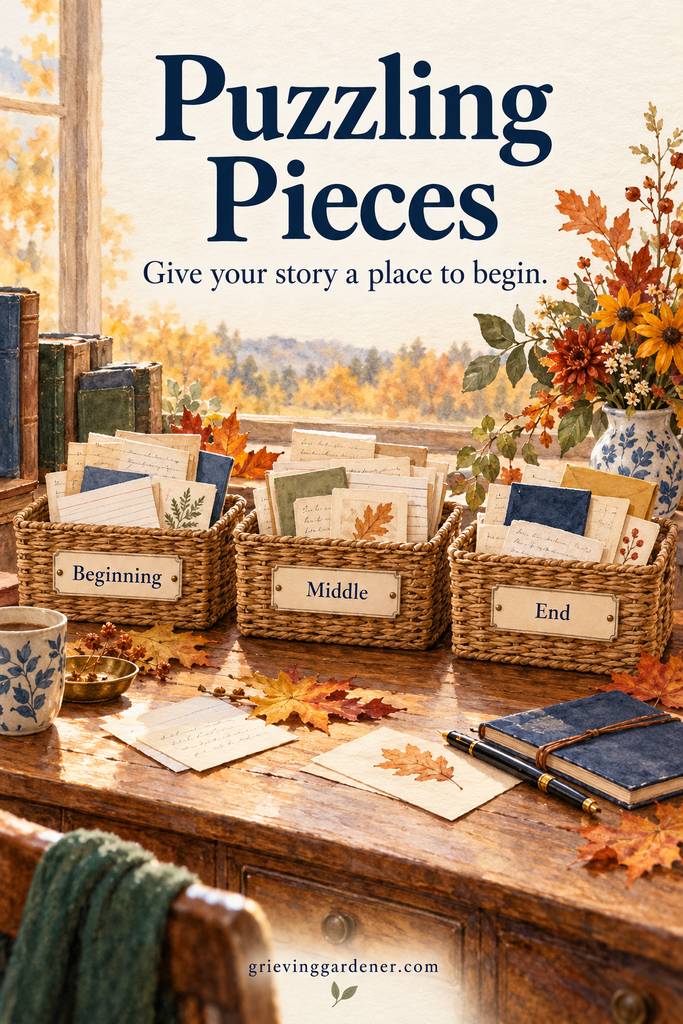
Beginning a book takes quite a bit of planning. Before the first chapter settles into place, a writer needs to build a skeleton. There needs to be some idea of how the story will be organized, what will stay, what will go, where the rhythm lives, and how the heart of the story will keep beating from beginning to end.
That sounds simple enough until the papers, memories, notes, photographs, letters, and half-formed ideas begin piling up.
When I wrote Widow: A Journey Toward Life, I learned that a book does not arrive neatly dressed and ready for company. It arrives in pieces. Some are beautiful. Some are painful. Some are confusing. Some seem important at first, but later turn out to belong somewhere else entirely.
So, I started the old-school way.
I used three baskets.
Beginning. Middle. End.
If I had a memory, I placed it in one of the baskets. If I had an idea, I wrote it on a 3×5 card. If something felt important but I did not know where it belonged, I gave it a temporary home. Slowly, the shape of the book began to appear.
Some pieces were removed after careful consideration. Some were moved from one basket to another. Sometimes I had to look at the same memory from a different angle before I knew where it belonged. That is part of the work.
After the baskets came chapters. After the chapters came lists of words and themes. I wanted to see how the ideas got along with each other. Grief. Hope. Loneliness. Courage. Faith. Waiting. Beginning again.
From there, the story began to tell itself.
Organizing a book is a little like uncluttering a closet. You start slowly. You take one thing at a time. You decide what still fits and what no longer belongs. And remember, you would not bring a car tire to live in your coat closet. Some things simply do not belong in the story you are telling.
That does not mean they are worthless. They may have a story of their own. Just not this one.
Through it all, ask yourself one question: Does this add to the story, or is it a rabbit hole that will lose my readers?
There is no one perfect way to organize a book. Use baskets. Use index cards. Use notebooks. Use folders. Use sticky notes. Use whatever helps you see the pieces clearly. The important thing is to begin.
Start with a skeleton.
After all, Halloween is just around the corner.
Have some fun with the bones of your story. Move them around. See what stands. See what dances. See what finally begins to live on the page.
Writing is life.