For the last six years, I’ve been on my own journey through life.
On April 8, 2020, my world changed in the darkest way I had ever known. I lost my best friend and husband of 32 years. At the same time, I was in the middle of selling our home and buying another—one that would be mine alone. Uncharted waters for a 64-year-old widow.
No single rule book exists for that journey. Each of us carries our own memories, faces our own fears, and finds our footing in our own time.
On April 9, 2020, I couldn’t have imagined how rich my life could become. I was trying to get through the day in front of me. Food, Shelter. Clothing. Survival.
Tears and loneliness were constant companions. With work, I kept putting one foot in front of the other. Somewhere along the way, I began to grow. Slowly, room opened up for something besides sorrow.
And through it all, I wrote.
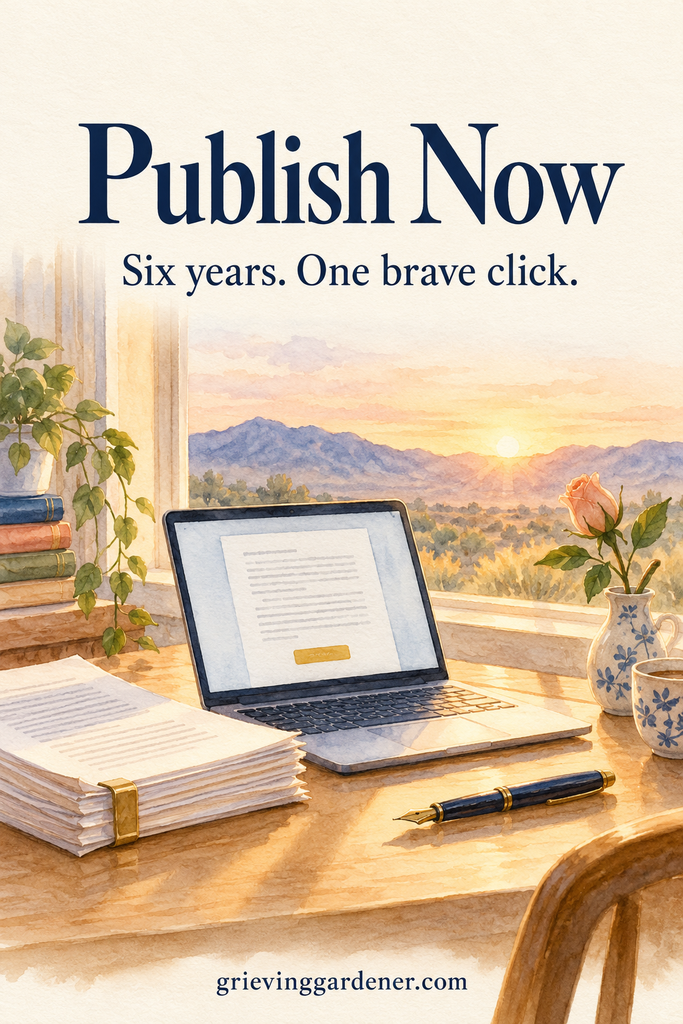
Saturday morning, after six years of working on Widow: A Journey Toward Life, it was time to publish my first book.
The editing was complete. The front and back covers were approved. The details were finalized. Only one thing was left to do. I pushed the button.
Publish Now.
Two little words after six years of work.
Today, I’m ordering my first box of books without those familiar words printed across the cover: “Not for Resale.” Finished books. Copies I can autograph and place in a reader’s hands. My book, published under my own Winterpast Publishing.
On November 11, 2026, Widow: A Journey Toward Life will officially be released. I will have my first book title under my belt.
And I am terrified.
Will anyone be interested? Will anyone order a copy? Will this story I have carried for so long mean something to someone else?
Well, I plan to buy one.
HHH will, too.
That’s two copies.
Every new author must start somewhere.
After years of work on this project, you would think I could set the doubts aside. Instead, those doubting devils chase me through my dreams. I have to shoo them away and keep believing in the work I have done.
Believe that there are readers who will recognize something of their own lives in these pages. Widows who understand the silence of a changed home. Friends who want to understand what someone they love is experiencing.
I hope my story offers them a little company.
Widow follows my first year after losing my husband. The ordinary days. The loneliness. The decisions that suddenly belonged to me alone. The small steps I could sometimes manage.
Looking back from where I stand today, I can see how much those steps mattered.
Writing this book has been another climb up the mountainside. Some days, the work came easily. Other days, I wondered whether I would ever reach the place where I could call it finished. But I kept climbing.
And now, I’m planting my flag. Writing about the most personal details I could share, I stayed with it, worked on it, and brought it to completion. I am so proud of that accomplishment. The nervous author in me may need a little time to catch up.
On November 11, Widow: A Journey Toward Life begins its journey into readers’ hands.
I would be honored if you were among them.